

AI is booming. And everything that makes it work is booming as well.
And that creates scarcity for some of the main building blocks. Computational hardware is a known problem, and RAM already costs a small fortune. But just because something is in the middle of the loudest hype, does it mean that it is the most important part?
What if the bigger problem lies somewhere much more boring, in something we barely even notice?
Electricity is the backbone of AI and everything behind it: data centers, computers, servers, and all the infrastructure that makes them work.
Connecting a datacenter to the electrical grid requires a huge amount of work and infrastructure. Electricity has to be generated, transmitted, transformed, and distributed. And one of the key elements that makes all of this possible is the transformer.
Transformers are essential on both sides of the grid. At large power plants, they increase the voltage to make long-distance transmission more efficient. On the consumer side, they reduce it to the levels required by factories, data centers, cities, and our homes. And between these two sides, electricity may pass through several more transformers before reaching its destination.
Now think about what happens when electricity demand grows. We need more generation capacity, more connections for new consumers, and often more infrastructure between them. New power plants need to be connected to the grid, and new consumers need to receive electricity from it. That means more transformers, more substations, and more equipment to make the whole system work.
But are transformers a real bottleneck? Do we have any problems here?
Surprisingly, yes. Increasing electricity demand, grid expansion, and the need to replace old equipment have created serious problems with transformer availability. For example, to the International Energy Agency, procuring a large power transformer can take up to four years.
Imagine building an entire datacenter and then discovering that you might have to wait years for the equipment needed to connect it to the grid.
But let’s say we have our transformer. What follows it?
Is placing a transformer between the grid and our consumer enough to deliver electricity safely and reliably? What happens when something goes wrong, and how do we make all these electrical components work together?
That’s what we’re going to figure out in this series.
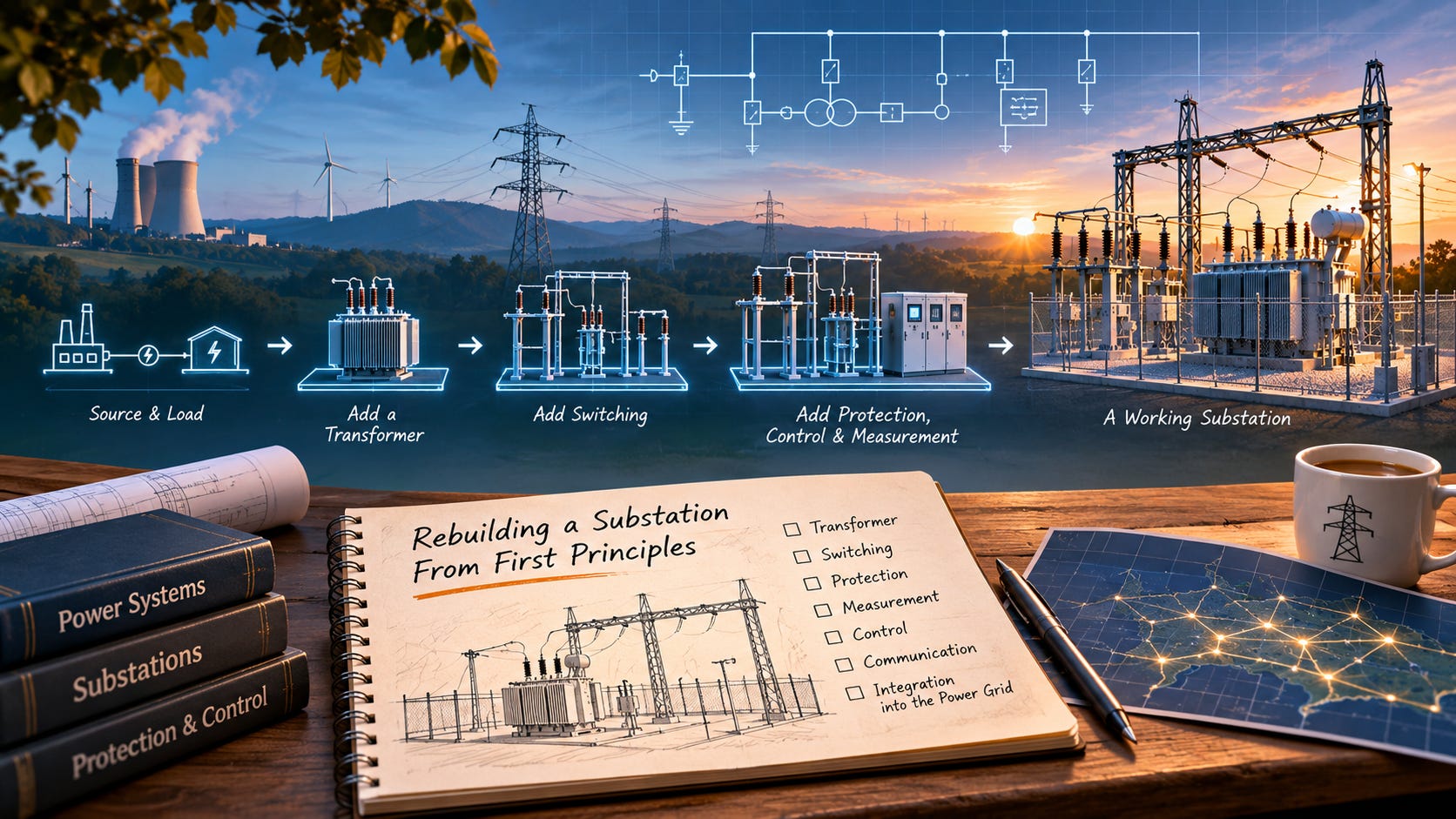
The AI boom is just an illustrative example, the hook I used, to show how almost everything that requires electricity depends on transformers and a much more complex system around them. A system that includes switching equipment, protection relays, measurement devices, control systems, and communication networks. Much of this equipment comes together in what we call a substation.
In this series, we’ll look at how a typical substation works, what parts it has, and what functions they perform. But instead of starting with an existing substation and explaining every component, we’ll try to rebuild one from first principles. We’ll start with a power source and a consumer, encounter problems along the way, and introduce new components as we figure out why we need them.
And most interestingly, we’ll look at how all these components communicate with each other, how they work together, and, perhaps even more importantly, how one substation is connected to a much larger, interconnected electrical network: the power grid.
This article will serve as the central hub for the series, and I’ll update it as new parts are published.